
Some moments make a home problem impossible to ignore any longer. One family remembered a holiday evening that ended early when smoke began filling a living room that should have been warm and full of people. The flue was blocked. Mortar between the bricks had deteriorated enough that sections of the chimney interior had partially collapsed.
The chimney had been sending warnings for a long time, white staining on the exterior brickwork, small fragments of brick appearing in the firebox, and crumbling mortar at the crown.
Nobody took those signs seriously until they had to. Chimney masonry problems do not pause and wait for a convenient time. They compound quietly until they become urgent.
What Happens Inside the Masonry Over Many Seasons
A chimney faces conditions that few other exterior structures deal with simultaneously. The interior experiences intense heat during use, which expands the masonry. The exterior faces cold temperatures, rain, wind, and freeze-thaw cycles that stress and contract the same materials. This repeated cycle of expansion and contraction, season after season, works progressively on mortar joints and brick faces. The mortar, which is intentionally softer than the brick, deteriorates first. Once the mortar fails, moisture enters the structure and accelerates brick deterioration significantly.
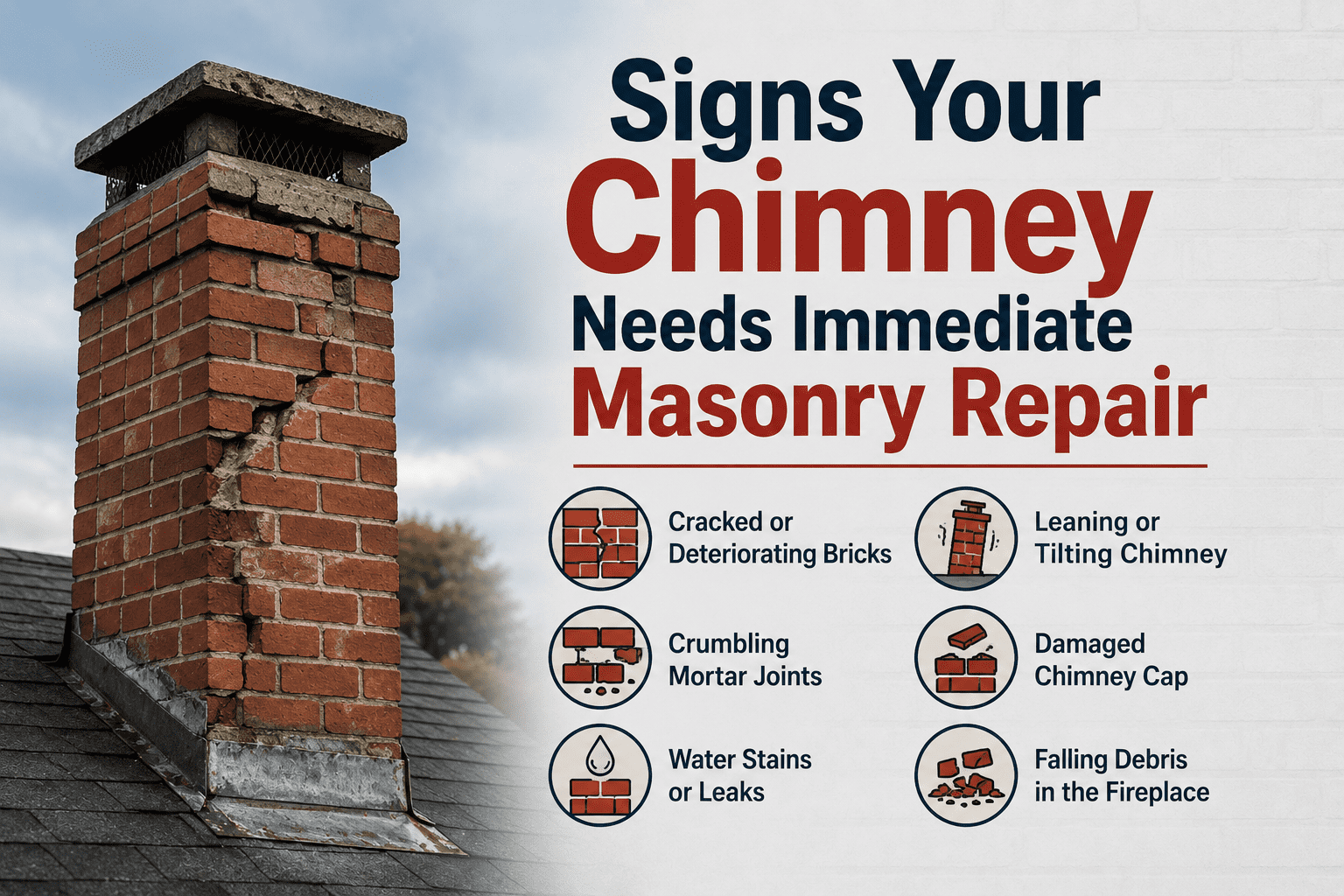
Cracked Bricks and Failing Mortar: Where the Damage Starts
Mortar joint deterioration is the most common chimney masonry problem. Mortar is mixed softer than brick, so it can act as a buffer and be replaced without damaging the surrounding brick. But when it is left to deteriorate beyond a functional state, the chimney’s structural integrity depends on direct brick-to-brick contact without a proper bonding agent. Bricks shift, gaps open, and the structure loses the rigidity it was designed to maintain.
Cracked bricks appear when thermal stress exceeds what the material can absorb, or when water that has entered a brick freezes and expands from within. Spalling, where the face of a brick flakes away in layers, is a sign that internal freeze-thaw damage has been occurring for some time, not a sign that the damage is just beginning.
Water Getting In Through Places It Shouldn’t
Water penetration is the primary driver of chimney masonry damage. Rain and snowmelt enter through deteriorated mortar joints, cracks in the chimney crown, damaged flashing, and compromised brick faces. Once inside the assembly, water causes several types of damage simultaneously. It weakens mortar and allows more water to enter. It saturates bricks, which then suffer accelerated freeze-thaw damage from within. It works toward the flue liner, where it causes additional deterioration and eventually creates leaks visible inside the home.
A Leaning Chimney Is Not Something to Monitor. It Is Something to Address.
A chimney that has shifted from vertical, even slightly, is displaying serious structural compromise. This kind of movement results from foundation settlement beneath the chimney, deterioration of the internal masonry structure, or lateral pressure from large root systems nearby. A leaning chimney does not self-correct. The movement continues as long as the underlying cause is unaddressed, and the risk of partial or complete collapse increases with time. This is not a situation to watch from a distance. It requires immediate professional evaluation.
Reading the Outside of the Chimney for Early Signals
Exterior warning signs are visible to anyone who takes a moment to look. Cracks running vertically or diagonally through the brickwork indicate movement or settlement. Mortar joints that appear recessed, crumbling, or absent in sections indicate weathering that has moved past surface-level wear. Missing or cracked sections of the chimney crown, the concrete cap surrounding the flue opening at the top, allow water to enter the chimney structure directly with every rain.
White staining on the exterior brick face, known as efflorescence, is a reliable indicator that water is actively moving through the masonry. It deposits mineral salts on the surface as it evaporates. It is not just cosmetic. It confirms that moisture is moving through the structure and causing internal deterioration that is not yet visible as cracking or spalling.
When the Damage Shows Up Inside the Home
Chimney problems frequently make themselves known through the home’s interior before exterior damage becomes fully apparent. Water stains on walls or ceilings near the chimney indicate infiltration at the roofline. A persistent musty smell in adjacent rooms is often caused by moisture that has entered the chimney structure and is slowly releasing into living spaces.
Smoke that enters a room when the fireplace is in use points to a blockage or structural collapse within the flue. Debris appearing in the firebox, pieces of brick, mortar, or flue liner tile, confirms that the interior of the chimney is actively deteriorating.
What Neglected Chimney Masonry Can Lead To
Structural collapse of a failing chimney can damage the roof, exterior walls, and anything or anyone nearby when it occurs. Water infiltration that progresses from the chimney into the attic or wall cavities causes wood rot, mold growth, and insulation damage, all of which are expensive to remediate. A compromised flue liner allows combustion gases, including carbon monoxide, to enter living spaces rather than exhausting safely. These are not minor inconveniences. There are serious safety and structural risks that worsen the longer they are left without attention.
Repair Options Worth Understanding
Tuckpointing removes deteriorated mortar from joints and replaces it with fresh material. It is one of the most effective and widely used chimney masonry repairs. Done correctly, it restores the structural bond between bricks and closes the pathways that have been allowing water to enter. The quality of tuckpointing work varies significantly depending on how deeply old mortar is removed and what mix is used as replacement.
Individual brick replacement addresses units that have spalled, cracked through, or failed structurally. Matching replacement brick to the original in color, size, and texture matters for both appearance and structural compatibility. Chimney crown repair or replacement seals the top of the chimney assembly against direct water entry. A properly built crown with a drip edge that extends beyond the brick face and slopes to shed water is the single most effective barrier against water intrusion at the chimney top.
How to Know When a Professional Is the Only Right Answer
Minor mortar joint repointing on accessible lower chimney sections can be within reach of a careful homeowner with the right materials and patience. Everything else, crown repair, structural assessment, flashing work, flue liner evaluation, and any repair requiring roof access, should be handled by someone with the appropriate equipment, training, and experience.
The height, the fire-safety implications, and the structural complexity of chimney work make professional involvement the correct call in almost every situation beyond the most basic surface maintenance.
Chimneys should be inspected annually, ideally before the heating season begins. An inspection that catches early mortar erosion costs a fraction of what structural repair or a full chimney rebuild costs once damage has progressed significantly.
Promaster Maintenance Corp performs chimney masonry repair and maintenance across Long Island, giving homeowners honest assessments and quality repairs that extend the life and safety of their chimneys.