
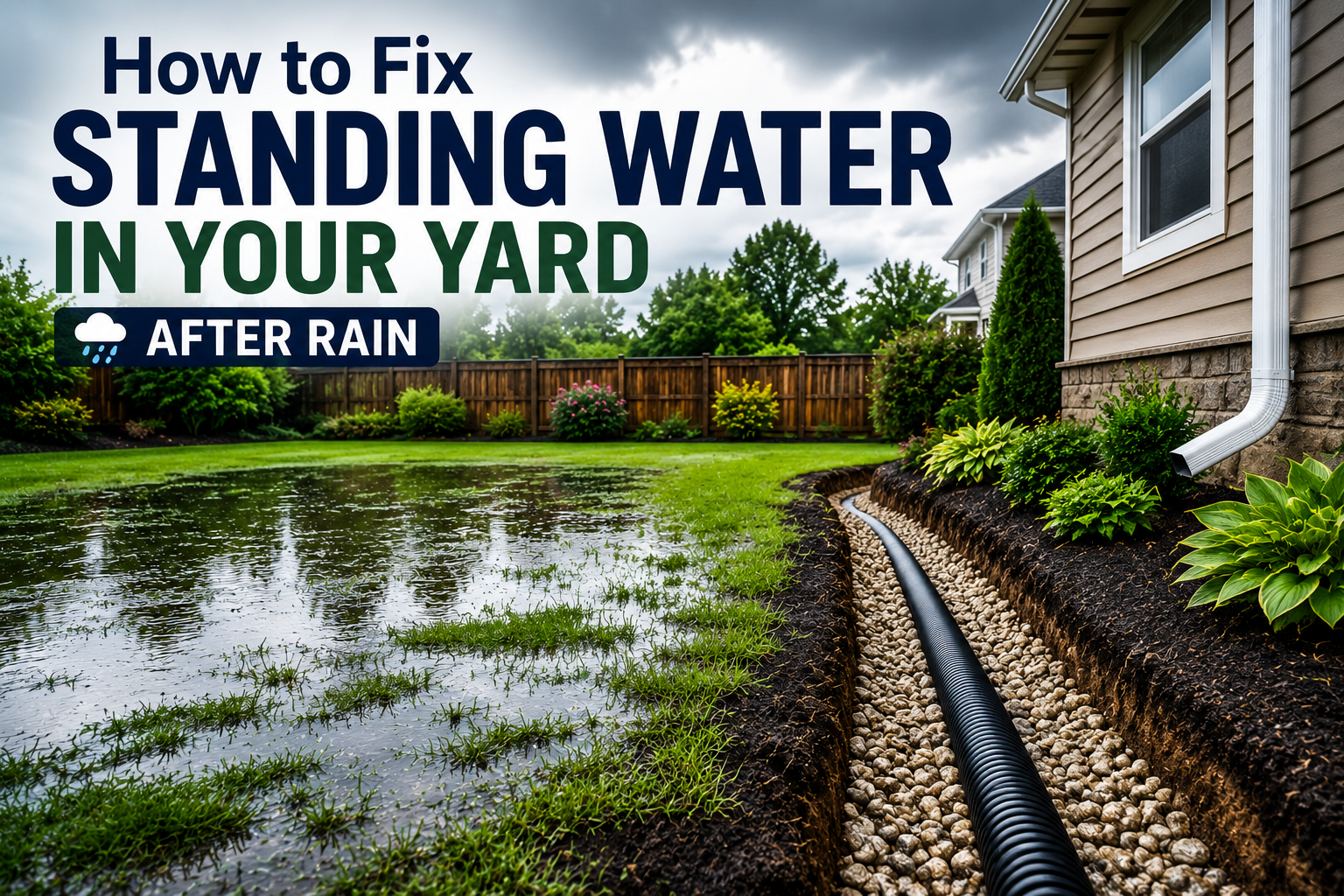
Some backyards had a way of turning into shallow ponds after a heavy rain, and everyone nearby knew it. Cookouts got cancelled. A kids’ birthday party planned for weeks moved indoors at the last minute.
Guests navigated around a soupy patch near the grill, too polite to say anything but clearly uncomfortable. Standing water is not just a scheduling problem.
Over time, it kills grass, promotes mosquito breeding, damages tree roots, and works its way toward a home’s foundation. Fixing it properly starts with understanding why the water is sitting there, not just where.
Reading the Yard to Find the Actual Cause
Water pools for specific, identifiable reasons. The most common are low spots, depressions where the ground dips enough to collect runoff from surrounding higher ground. These form naturally as soil settles over time. They also develop after renovation or landscaping work that disturbs the grade and is not corrected before the project finishes.
Soil composition plays a significant role. Clay-heavy soil absorbs water slowly and holds it for long periods. Compacted soil, which is common in yards with heavy foot traffic or lawn equipment, loses its ability to absorb water effectively. Water sits on the surface rather than moving through it. Identifying the soil type and structure underneath informs which solution will actually work.
Why Water Stops Moving Through the Lawn
Blocked or undersized drainage paths are a less obvious cause of persistent pooling. Many properties have drainage easements, underground pipes, or surface channels designed to move water away. When these become clogged with debris or overwhelmed by heavy rainfall, water backs up in low areas. In older properties, the original drainage design may not accommodate changes that have happened over the years, including new structures, expanded impervious surfaces, or grade shifts from decades of landscaping work.
Immediate Steps When the Water Is Already There
A submersible pump removes standing water from a concentrated low spot in a matter of hours. This is useful when pooling is deep enough to cause damage or block access. It does not fix the underlying problem, but it buys time for a proper solution to be planned and implemented.
Core aeration improves short-term absorption by pulling small plugs from compacted soil and creating channels for water to enter. It is not a permanent drainage solution, but it helps a compacted lawn absorb rainfall more effectively while longer-term work is being arranged. Temporary surface channels or sandbag barriers can redirect water away from problem areas while the permanent fix is underway.
Fixing the Grade: The Solution That Addresses the Root
Regrading is the most effective fix for yards that pool because of low spots or improper slope. A properly graded yard directs water away from the house at a minimum slope of one inch per foot for the first six feet. Beyond that, the grade should continue directing runoff toward the street, a drainage area, or an appropriate outflow point.
Smaller regrading projects are achievable for determined homeowners with rented equipment. Larger projects, particularly those involving the grade near the foundation, are better handled professionally. Improper regrading can shift pooling problems to a different part of the yard or, worse, direct water toward the home rather than away from it.
French Drains: Old Name, Still One of the Best Tools
A French drain is a gravel-filled trench containing a perforated pipe installed below the surface in areas where water consistently accumulates. Water enters the pipe through its perforations and travels to a lower elevation, a dry well, a street drain, or a municipal system. French drains work passively with no mechanical components to maintain or replace over time.
They need to be correctly sloped to function. A drain that runs flat or uphill collects water rather than moving it. The outlet location must also be thoughtfully chosen. Water discharged incorrectly creates new problems for adjacent properties or the home itself.
Dry Wells and Channel Drains for More Complex Situations
A dry well is an underground chamber that collects water and allows it to disperse slowly into the surrounding soil. It works well where pooling is moderate, and the soil has reasonable percolation rates. It is not effective in clay-heavy soils with very low absorption capacity.
Channel and trench drain systems capture water at the surface and direct it quickly to an outflow point. They are particularly effective along driveways, at the base of slopes, and in areas where water sheets across a surface after rain. Both options can be combined with French drains in yards that have layered or complex drainage challenges.
Landscaping That Works With Drainage, Not Against It
Plant selection and garden placement have a meaningful effect on how water moves through a yard. Rain gardens, planted depressions filled with water-tolerant native species, absorb runoff and allow it to infiltrate naturally. Deep-rooted native plants improve soil permeability over time. Permeable ground cover alternatives to compacted turf reduce the volume of runoff generated during heavy rain events.
Hardscaping decisions also affect drainage. Large areas of solid paving create more runoff than permeable alternatives. Permeable paver options for patios and walkways allow water to pass through rather than sheet across the surface toward the lowest point in the yard.
Keeping the Fix From Becoming Next Year’s Problem
Maintenance determines whether a drainage fix stays effective. French drains and channel drains should be flushed periodically to prevent sediment blockage. Gutters and downspouts should discharge water well away from areas that previously pooled. Annual lawn aeration prevents soil from compacting back to where it was. Any new landscaping or hardscaping should be graded before installation, not after.
Standing water is almost always fixable. The fix just has to match the actual cause rather than just the visible symptom. Promaster Maintenance Corp has helped Long Island homeowners diagnose yard drainage problems correctly and install solutions that hold up through every wet season.